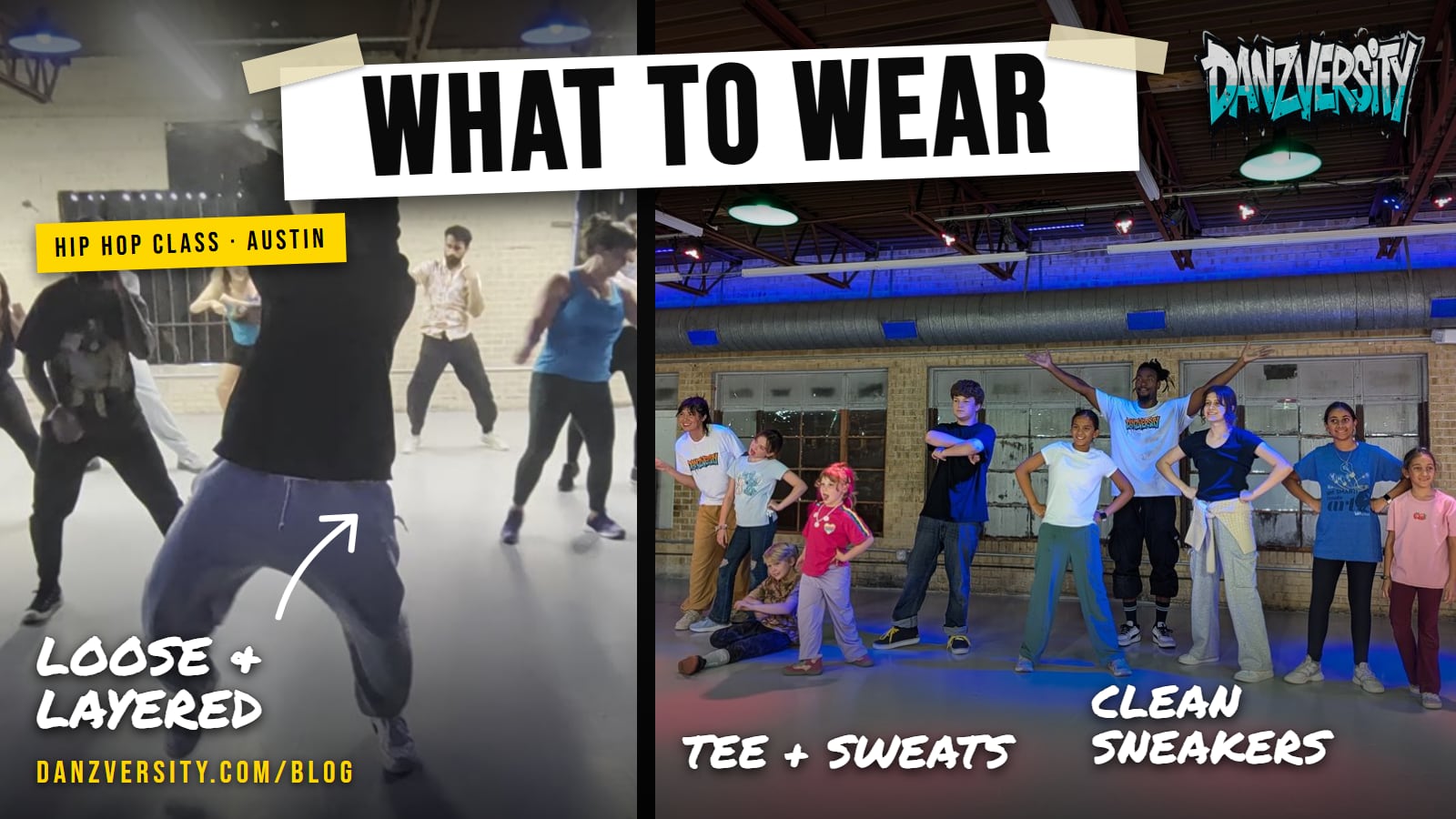
Quick answer: a t-shirt, sweatpants or loose pants, and clean sneakers. Layers on top if you run cold. That’s the whole list. No special shoes, no dancewear, nothing to buy.
But there’s a reason the list looks like that, and it isn’t just comfort. What you wear to a Hip Hop class changes how you move, how the moves read, and how you feel in the room. Here’s the why.
- T-shirt Loose. Oversized is great.
- Sweatpants or comfortable pants Joggers, cargos, track pants. Anything with room.
- Clean sneakers A pair you don’t wear outside is ideal.
- Layers Hoodie or flannel to start, down to the tee once you’re warm.
- Shorts, skirts, dresses
- Crop tops, sports bras as tops
- Jeans or anything stiff
- Open-toed shoes, boots, heels, socks only
THE LOOK CAME FROM THE STREET
Hip Hop wasn’t born in a studio. It started at block parties in the Bronx in 1973, outdoors, on concrete, with people dancing in whatever they had on. Jeans got swapped for track pants because track pants let you drop to the floor and get back up. Loose tees and layers were what people wore in the park, and they turned out to be the best thing to dance in.
So the baggy silhouette isn’t a costume. It’s the original uniform. When you walk into a Hip Hop class dressed like that, you’re honoring where the dance came from before you’ve taken a single step.
YOUR CLOTHES CHANGE HOW YOU MOVE
There’s a name for this: enclothed cognition. Researchers put people in a white lab coat and told half of them it was a doctor’s coat and half it was a painter’s coat. The “doctor” group paid closer attention on the task that followed. Same coat. Different meaning. Different performance.1
Dancers feel this every day. Put on loose clothes that move with you and your body says: okay, we’re doing Hip Hop now. Grooves sit deeper. Hits land harder. You stop thinking about yourself and start listening to the music.
The opposite is true too. In tight or revealing clothes you spend the class adjusting, tugging, checking the mirror. Your attention is on your outfit instead of the beat. That’s not a confidence problem. It’s a clothing problem, and it’s an easy fix.
LOOSE FABRIC SHOWS THE DANCE
Hip Hop lives in contrast: a sharp hit, then a smooth wave. Grounded footwork, then a float. Loose clothes make that contrast visible. A baggy pant leg snaps when you stop and flows when you glide. A loose tee shows an isolation in your chest or a wave through your shoulders in a way a fitted top never will.
That’s why the same move looks like more in the right clothes. Your technique didn’t change. The fabric is finally telling the story with you.
IT’S FLOOR WORK. COVER YOUR KNEES.
Here’s the practical side. Hip Hop and breakin’ are big movement and a lot of floor. Knees, hips, shoulders, and sometimes your back all meet the ground. Sweatpants protect skin. Shorts and skirts don’t, and they don’t stay where you put them when you’re upside down.
Same for the top. A loose tee covers you through every drop, roll, and freeze. A crop top or sports bra as a top doesn’t, which is why those belong in a different class, not this one.
Sneakers: clean, closed-toe, and ideally a pair you keep for the studio. Good ankle support helps for breakin’. Flip-flops, boots, heels, and socks-only are out. You need grip to stop and a sole to pivot on.
WHAT ABOUT “DANCE CLOTHES”?
We get this a lot from parents coming from ballet or jazz. Leotards, tights, booty shorts, and sports bras are built for those styles. They aren’t wrong. They’re just wrong here. Hip Hop in a leotard looks like ballet in sneakers: the technique can be perfect and it still reads off.2
So no, you don’t need to buy anything. Your kid almost certainly owns a tee, sweatpants, and sneakers already. That’s the point. This dance was built to be accessible, and the clothes are too.
OUR DRESS CODE, AND WHY WE HOLD IT
Every Danzversity kids’ program, from Root Runners (ages 2–4) through Elementz Crew (13–17), runs the same dress code every class: t-shirt, sweatpants or comfortable pants, sneakers. No dresses, skirts, shorts, crop tops, or open-toed shoes. Kids who show up out of dress code are asked to change before they join the floor.
We hold it for three reasons. It keeps kids covered and protected during floor work. It takes clothes off the table as a distraction so class is about the dance. And it teaches the culture from day one: this is how Hip Hop dresses, and here’s why.
For adults, the rule is the same idea with less enforcement: baggy, loose, comfortable. Room to bounce, room to breathe. Skip the jeans.
LAYER UP, THEN PEEL DOWN
The studio gets warm fast. Start class in a hoodie or flannel over your tee, then drop the layer once you’re moving. Layers aren’t just practical. They’re the look. Loose and layered is Hip Hop at its most classic, and it gives you something to do with your hands in the cypher.
“Dance to express, not impress.”
— Jaymie Orozco-Howard, Danzversity
Your clothes should let you express. Loose, covered, grounded, ready to move. Then forget about them and dance.