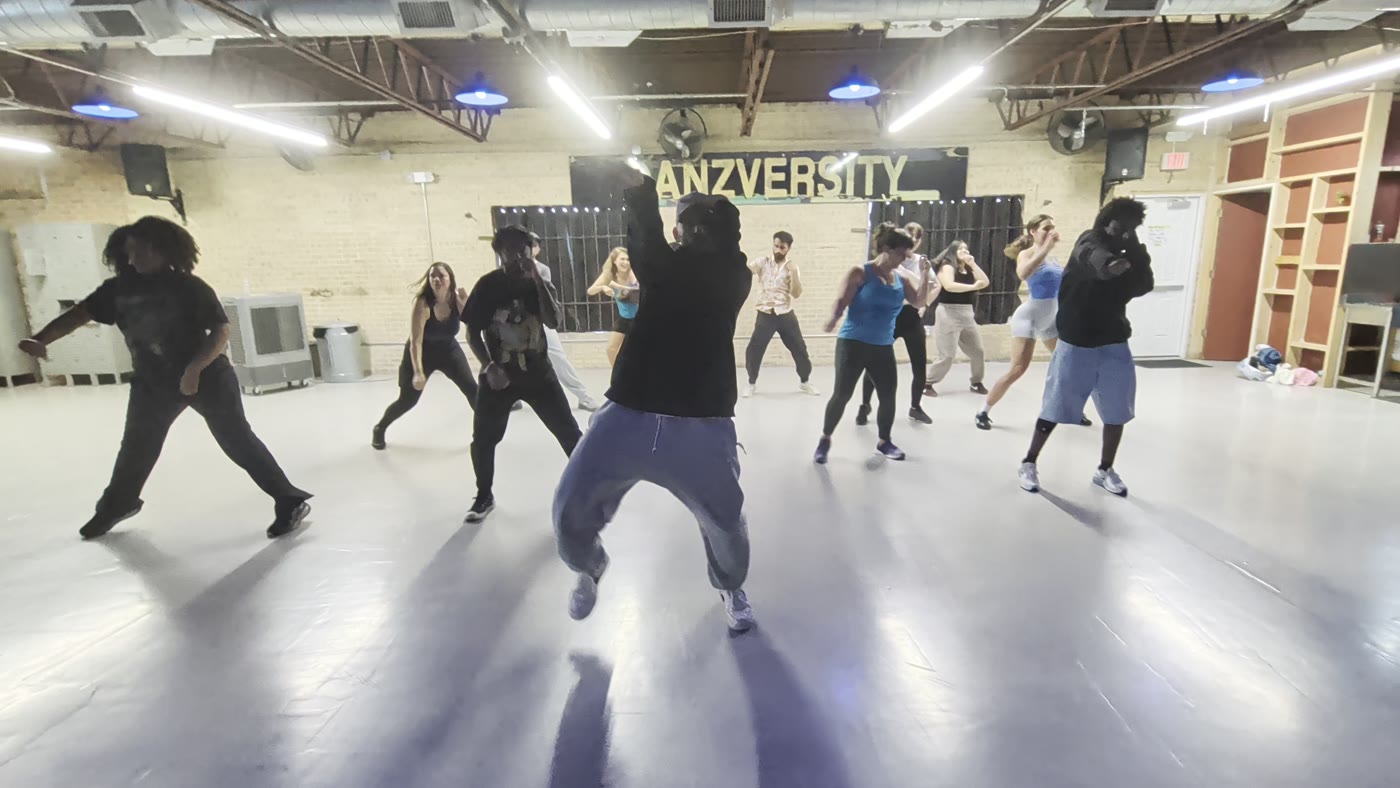
Quick answer: learn the groove before the moves, drill six foundation steps to music, practice ten minutes a day, and start freestyling sooner than feels comfortable. Then get in a room with people who can watch you and correct you. That’s the whole plan, for kids and adults.
Here’s each step, why it works, and what to skip.
1. START WITH THE GROOVE, NOT THE CHOREOGRAPHY
The most common beginner mistake is learning a routine first. You copy an 8-count from a video, it looks stiff, and you decide you can’t dance. The routine wasn’t the problem. The groove underneath it was missing.
A groove is the way your body rides the beat. In hip hop it starts with two things:
- The bounce. Knees soft, a small down-up on every beat. Down on the beat is the most common start.
- The rock. Your chest and shoulders rock forward and back, or side to side, in time.
Put on any hip hop song and do just the bounce for a full song. Then just the rock. Then both. It feels too simple. It isn’t. Every step you learn later sits on top of this, and dancers who skip it look like they’re doing moves instead of dancing.
2. LEARN SIX FOUNDATION STEPS
You don’t need fifty moves. You need a handful you can do without thinking, so your attention can go to the music. Start here:
- The two-step. Step side, close, step the other side, close, with the bounce under it. The base of almost everything.
- The running man. A pull-back step that looks like running in place. Great for rhythm and coordination.
- The kick ball change. Kick, step on the ball of the foot, change weight. Teaches quick weight transfer.
- The cabbage patch. Arms circle at chest height while you bounce. Trains upper body and lower body to work separately.
- The wop. A rolling chest and shoulder groove from the late ’80s. Good for loosening up.
- Top rock. The standing footwork that opens a breakin’ round. If you’re curious about breakin’, start it early.
Learn one a week. Do it slow, then at half speed with music, then at full speed. When you can do it while talking to someone, it’s yours.
3. PRACTICE TEN MINUTES A DAY, TO MUSIC
Ten minutes every day beats an hour once a week. Short, frequent practice is how the body files a movement away so it shows up on its own later.
A simple daily ten:
- 2 minutes: bounce and rock to one song.
- 5 minutes: this week’s step, slow then up to speed.
- 3 minutes: freestyle. Use whatever you know. No stopping.
Always practice to music, never to counting alone. Hip hop is a conversation with the beat. Counting teaches you the steps; music teaches you the dance.
4. FREESTYLE SOONER THAN FEELS COMFORTABLE
Most beginners wait to freestyle until they “know enough.” Nobody ever feels like they know enough. Start in week one, with two moves and a bounce.
Freestyle is where you stop copying and start making choices: which step, when to switch, how big, how sharp. That decision-making is the actual skill. A dancer with five steps and good choices looks better than a dancer with fifty steps and no idea what to do next.
In hip hop, people freestyle in a cypher, a circle where dancers take turns in the middle. It looks intimidating from the outside. Inside, it’s the friendliest part of the culture: everyone in that circle was a beginner once, and the circle cheers for trying.
5. GET FEEDBACK FROM SOMEONE WATCHING
You can learn a lot from videos. What a video can’t do is see you. Small things decide whether a step looks right: where your weight sits, whether you’re on the beat or slightly ahead, whether your knees are actually soft. Those are almost impossible to catch on your own.
That’s the real reason to take a class. Not to learn more moves, but to get corrected on the ones you have, and to dance in a room full of people at your level.
6. KNOW WHERE THE DANCE CAME FROM
Hip hop dance didn’t start in a studio. It started at block parties in the Bronx in 1973, with DJs, MCs, graffiti artists and dancers sharing the same space. Knowing that changes how you dance. The steps stop being tricks and start being a language with a history, and you start dancing it with respect instead of imitation.
If you want the longer story, start with the history of hip hop, from the Bronx to Austin.
WHAT TO SKIP AS A BEGINNER
- Viral routines first. Fun, but they skip the groove. Learn them after you have one.
- Power moves on day one. Headspins and flips come from years of foundation. Start with top rock and footwork.
- The mirror the whole time. Use it to check a step, then look away and feel the music.
- Special clothes. A tee, sweats and sneakers is the uniform. Here’s what to wear to hip hop class, and why.
HOW WE TEACH IT AT DANZVERSITY
Every class at Danzversity works on the same four things at once. We call them the Elements, and they’re not levels you pass through. You work on all four your whole life as a dancer:
- Earth: foundation. Posture, groove, rhythm, the core steps.
- Air: expression. Freestyle, your own voice, the cypher.
- Water: flow. Musicality and the transitions between moves.
- Fire: performance. Energy and presence when people are watching.
That’s the Elemental Dance Method™. A beginner spends more time on Earth, but even the first class touches all four.
Where to start:
- Adults: (Found)ations, Monday through Thursday at 7:00 PM, built for people who have never taken a class. Every class closes with The Session, a short live cypher.
- Kids and teens: four age groups from 2 to 17, Tuesday and Thursday afternoons plus Saturday mornings for the youngest.
- Breakin’: its own program for ages 8 to 17. Start at the breakin’ page.
QUESTIONS PEOPLE ASK
Can I learn hip hop dancing at home?
Yes, you can learn the basic steps at home from videos. What you can't get at home is someone watching you and correcting the small things, and a room of people to dance with. Most people learn fastest with both: practice at home, then a class for feedback.
How long does it take to learn hip hop dancing?
Most beginners feel comfortable with a basic groove in a few weeks of regular practice, and comfortable freestyling for a short round in a few months. It depends on how often you practice, not on talent.
Am I too old to start hip hop dance?
No. Hip hop started at block parties where everyone danced. Our adult (Found)ations class is built for people who have never taken a dance class, at any age.
How old does a child need to be to start hip hop?
Kids can start at 2. Root Runners is for ages 2 to 4, Flow Finders 5 to 7, Vibe Builders 8 to 12, and Elementz Crew 13 to 17.
What should I wear to a beginner hip hop class?
A t-shirt, sweatpants or loose pants, and clean sneakers. No special dancewear.
“Dance to express, not impress.”
— Jaymie Orozco-Howard, Danzversity